Making invisible
injury risk visible.
A field-deployable athlete evaluation system combining wearable IMU sensing, IoT communication, machine learning and explainable coaching support for long jump athletes.
My Contribution
Module 2 — Wearable Injury-Risk Screening
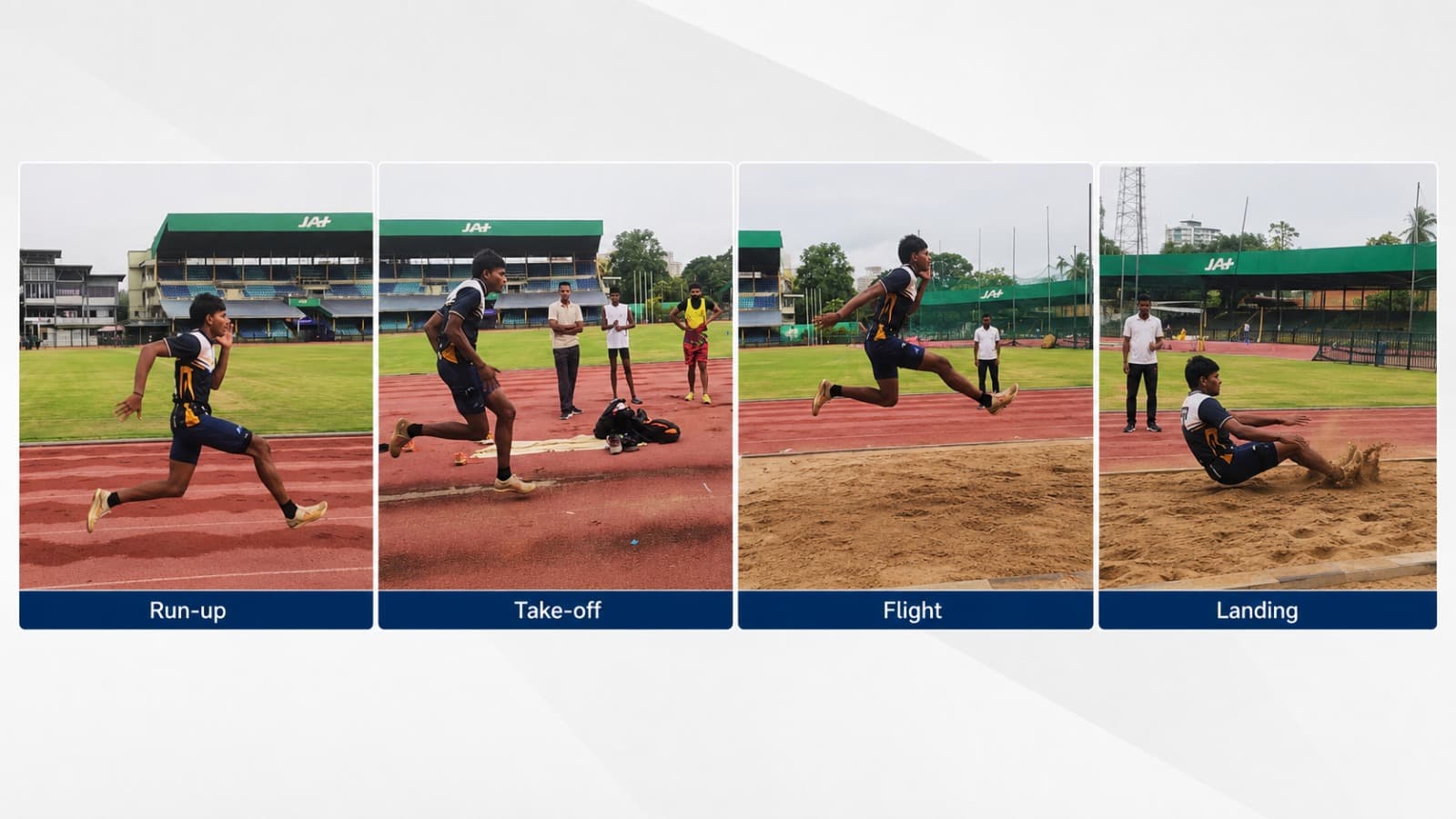
Subtle biomechanical errors are hard to see at full speed.
Long jump performance depends on run-up speed, explosive power, body control, take-off mechanics, stride behaviour, flight technique and landing stability. Experienced coaches can catch obvious errors, but subtle deviations during fast movement are easy to miss — and lab-grade motion-capture and force plates are expensive, technically demanding and inaccessible to most school, university and community-level athletes.
How Athletes Are Evaluated Today
Coach observation
Manual measurements
Athlete self-reporting
Expensive laboratory equipment
Separate tools that analyse only one part of performance
What This System Combines
An Integrated Evaluation Platform
Research Aim
To develop a data-driven, athlete-specific long jump performance evaluation and advisory system that estimates optimal performance, predicts injury risks, and provides personalised run-up and technique recommendations using low-cost measurable data.
Objective 01
Develop a machine-learning model that estimates optimal long jump performance from anthropometric and power-related measurements
Objective 02
Collect athlete-performance data using smartphone sensors, wearable sensors, video, and standard athletic measurement tools
Objective 03
Predict knee, ankle, and hamstring injury risks using technique and injury-history data
Objective 04
Recommend athlete-specific run-up speed and stride configurations
Objective 05
Integrate performance prediction, injury analysis, and technique-sensitivity analysis
Objective 06
Present understandable recommendations for athletes and coaches
One team, three connected modules.
Built by Team Aithusa at the Faculty of Information Technology, University of Moratuwa. My primary contribution was Module 2 — highlighted below.
Module 1
Potential Jump Distance Prediction
Estimates an athlete's maximum potential distance from height, body mass, shoulder width, leg length, CMJ height, peak vertical force and rate of force development.
Predicted optimal distance, actual distance, performance gap, key physical factors
Module 2
My ContributionInjury Risk Prediction
Uses wearable and smartphone sensor data, athlete characteristics and injury history to predict overall injury-risk level, likely injury category, and key contributors.
Injury-risk level, injury category, biomechanical contributors, prevention recommendations
Module 3
Run-Up Speed & Stride Optimisation
Analyses run-up speed, stride frequency, velocity drop, penultimate-step behaviour, stride count and flight technique.
Explainable technique recommendations using SHAP
Wearable IMU & ML-Based Injury-Risk Screening.
Core Research Question
“Can a low-cost wearable sensing system and machine-learning pipeline identify technique-related lower-limb injury risk in long jump athletes during field-based training?”
Why Existing Methods Fall Short
Coach Observation
Useful but subjective and may miss subtle, high-speed movement deviations.
Video Analysis
Provides visual evidence but requires manual frame-by-frame review and misses full 3D motion.
Motion-Capture Labs
Accurate but expensive and difficult to use during routine field training.
Force Plates
Useful for force analysis but don't independently provide continuous orientation data.
My Responsibilities — Full Module 2 Design & Implementation
Reviewing sports-injury biomechanics research
Identifying the research gap
Designing the wearable sensing platform
Integrating two BMI160 IMU sensors
Integrating the NodeMCU ESP8266
Adding clap-based synchronization
Adding an OLED status display
Designing real-time wireless data acquisition
Developing the WebSocket communication pipeline
Designing sensor calibration and recording workflows
Processing and cleaning sensor data
Extracting biomechanical features
Combining sensor data with athlete information
Developing two independent classification tasks
Comparing multiple machine-learning algorithms
Selecting the final models
Evaluating predictions
Generating athlete-specific injury-risk outputs
Integrating Module 2 with the overall system
A complete system, not a list of parts.
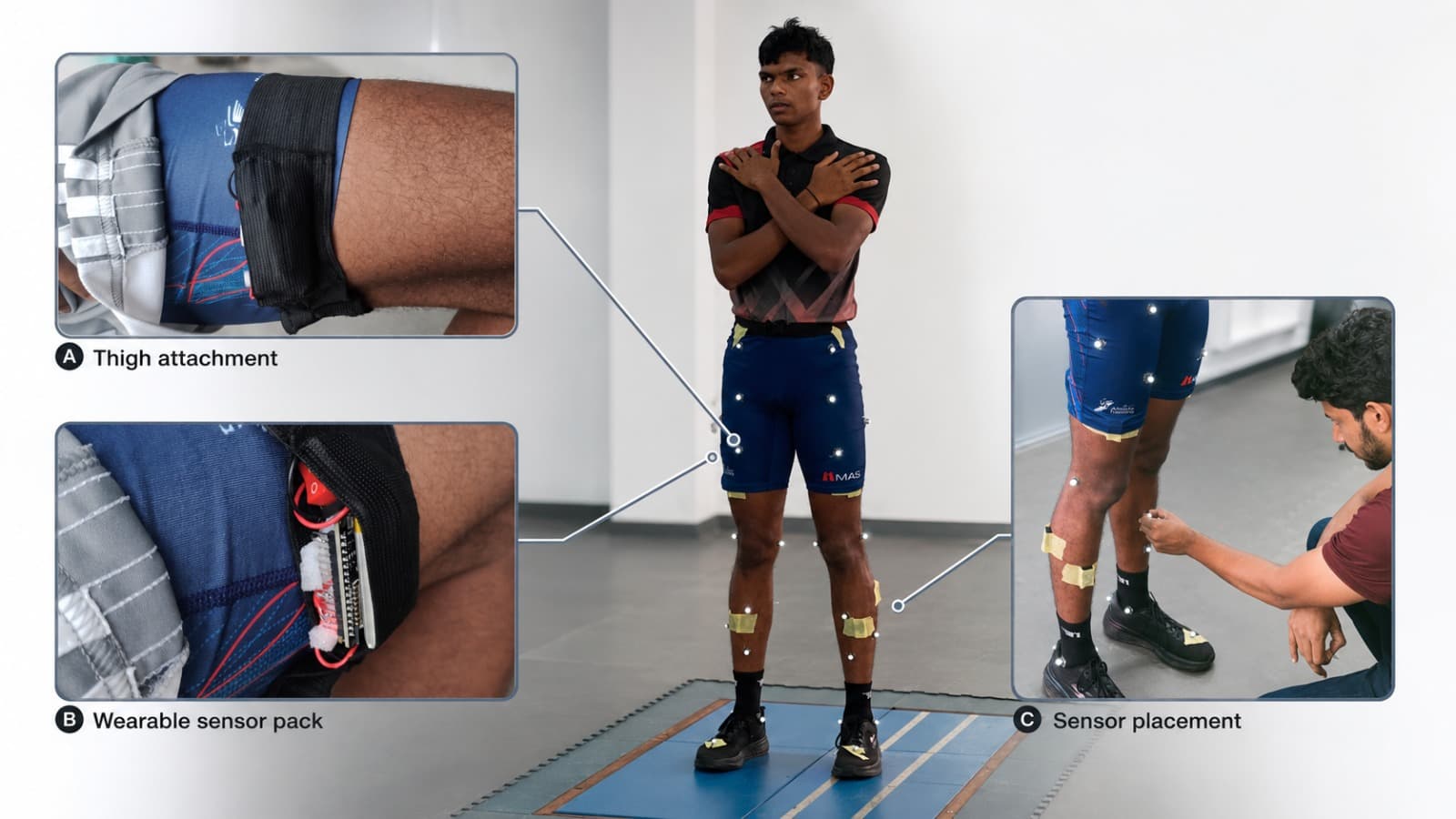
Dual-IMU wearable prototype: captures acceleration, angular velocity and body orientation during long-jump take-off and landing.
NodeMCU ESP8266
Central microcontroller — reads sensors, manages Wi-Fi, connects to the server, transmits real-time data and coordinates feedback.
Dual BMI160 IMU Sensors
Capture acceleration, angular velocity, orientation, pitch and roll — two sensors for more detailed lower-limb motion observation.
KY-038 Sound Sensor
Detects a hand clap as a synchronisation event, with threshold adjustment, debouncing and armed-state logic to reduce false triggers.
0.96" OLED Display
Real-time device feedback — Wi-Fi status, server connection, calibration, waiting-for-clap, recording status and errors.
Battery & Charging Module
Rechargeable battery system for portable field use.
Custom PCB (EasyEDA)
Integrates the NodeMCU, BMI160 sensors, KY-038, OLED, power components and connectors for portability and reliability.
From lab calibration to live field trials.
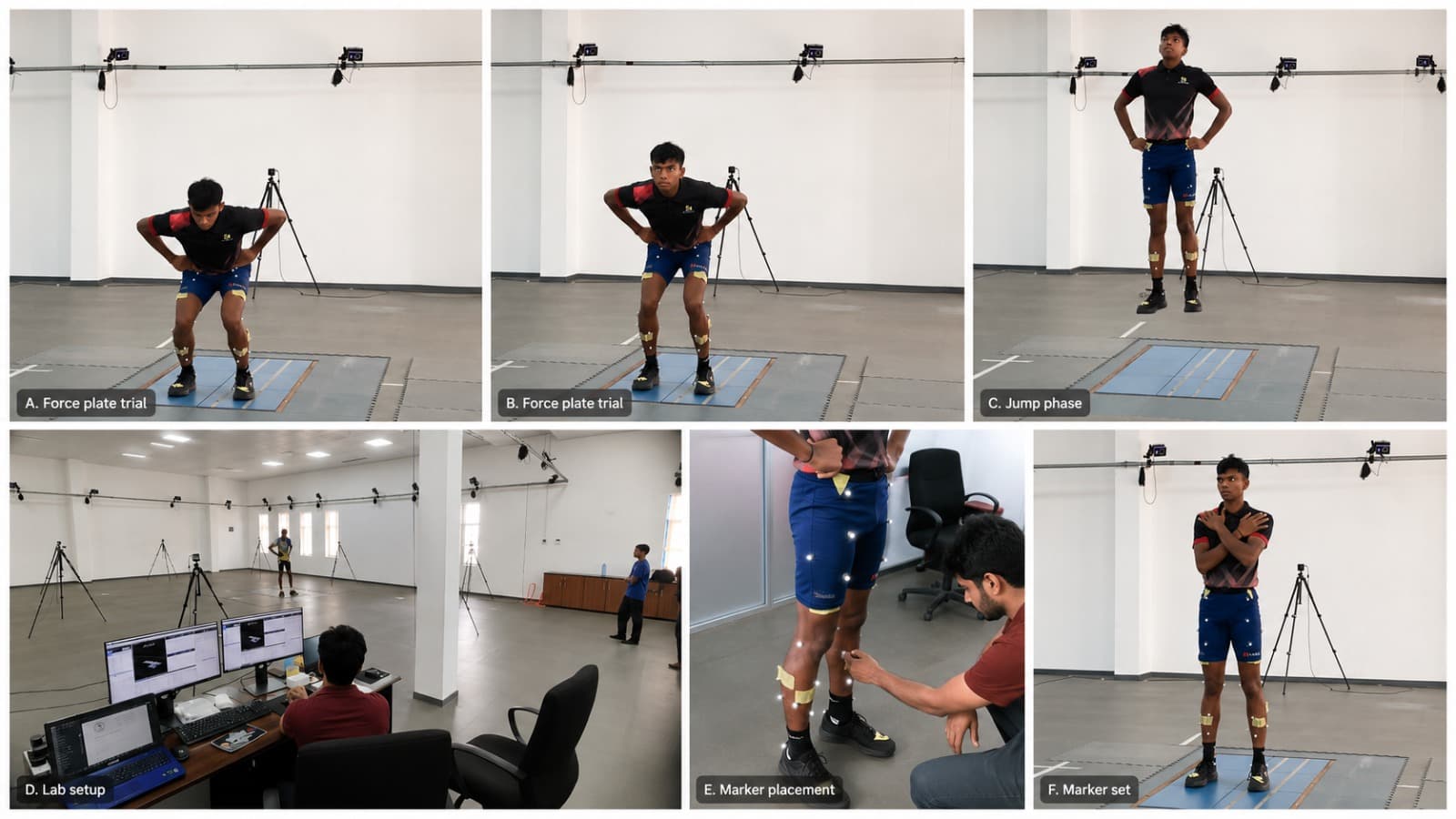
Lab-based reference session used to validate force-plate and marker-based measurements alongside the wearable system.
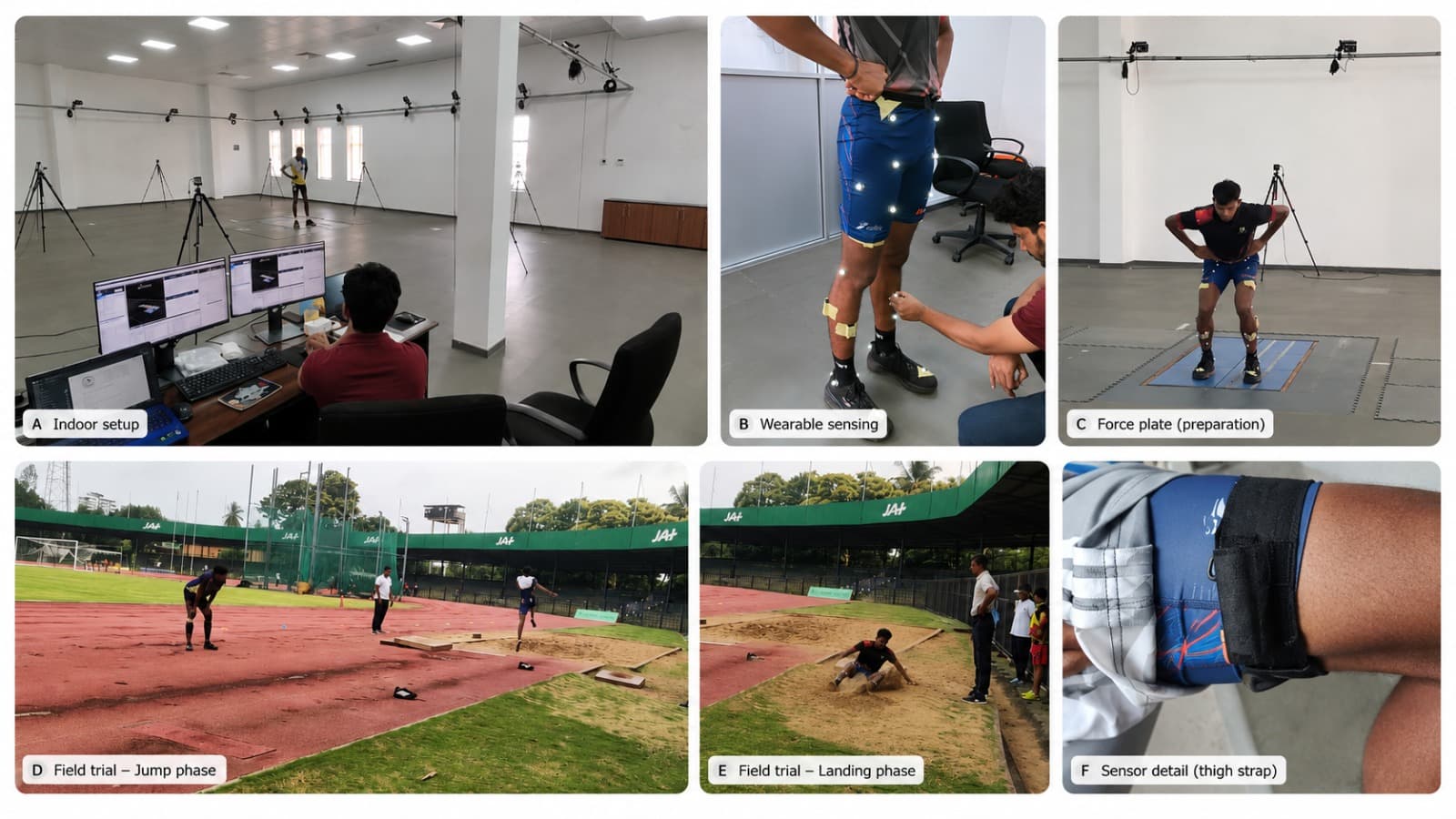
Field trials on the athletics track — the real deployment environment the wearable was designed for.
Clap-Based Synchronisation
A hand clap detected through the KY-038 sound sensor creates a clear, shared reference point aligning wearable sensor data, mobile/video recording and the session timeline — essential for matching movement data to the correct trial.
Session Workflow
Raw motion data into structured features.
WebSocket was selected because it maintains a persistent bidirectional connection — enabling continuous sensor streaming, immediate device-status updates, recording commands and low-latency session control.
Preprocessing Pipeline
Feature Categories
Acceleration
Peak acceleration, mean acceleration, acceleration variation, axis-specific changes, impact-related values
Angular Velocity
Maximum angular velocity, mean angular velocity, rotation variability, sudden rotational changes
Orientation
Pitch, roll, body-orientation deviations, stability during movement, landing orientation
Movement Stability
Signal variance, movement consistency, irregular motion, technique asymmetry indicators
Athlete Context
Anthropometric variables, training-related characteristics, previous injury information
Two separate questions, two separate models.
The model that performs best for general risk severity may not perform best for identifying injury type — so Module 2 trains two independent classification models rather than one.
Model A — Injury-Risk-Level Classification
Supports training-load and safety decisions. Final model: TabPFN.
Accuracy
95.2381%
Precision
95.6710%
Recall
95.2381%
F1-score
95.0113%
Model B — Injury-Type Classification
Provides specific direction for coaching review. Final model: Extra Trees with GridSearchCV.
Accuracy
80.9524%
Precision
79.5238%
Recall
80.9524%
F1-score
79.7884%
Algorithms Compared Before Final Selection
Selection considered accuracy, precision, recall, F1-score, ROC-AUC where applicable, confusion matrices, cross-validation, class behaviour and practical injury-screening implications — not accuracy alone.
Reading These Numbers Responsibly
The held-out test set for Module 2 contains approximately 21 records — one prediction changes accuracy by ~4.76 percentage points. The dataset is small, random trial-level splitting may allow the same athlete to appear in both train and test sets, and athlete-grouped validation is recommended before making claims about unseen athletes. These results should be read as prototype-stage screening performance, not clinical validation.
High risk always overrides performance.
Example Athlete Output
Athlete ID: ATH001
Overall Injury Risk: Moderate
Likely Injury Category: Knee Injury
Key Contributing Factors
— Landing orientation deviation
— Increased angular-velocity variation
— Prior knee-injury history
Recommendation
Review landing alignment and reduce aggressive progression until technique is assessed.
When Risk Is High, the System Never Recommends
Increasing run-up intensity
Increasing training load
Aggressive performance progression
Ignoring technique deviations
Instead It Prioritises
Technique review
Reduced load
Additional monitoring
Coach assessment
Qualified sports-health evaluation where appropriate
One athlete, one combined report.
An athlete may have a large unrealised performance gap, but a High injury-risk classification should change the recommended training strategy — this combined view prevents a narrow focus on jump distance alone.
| Athlete ID | ATH001 |
| Predicted optimal distance | 6.85 m |
| Actual jump distance | 6.42 m |
| Performance gap | 0.43 m |
| Potential achievement | 93.72% |
| Injury-risk level | Moderate |
| Likely injury category | Knee Injury |
| Module 3 result | Below expected |
Technology Stack
ML & Data
Python, Scikit-learn, XGBoost, TabPFN, Extra Trees, SHAP, NumPy, Pandas, Jupyter, Colab, Kaggle
Hardware
Dual BMI160, NodeMCU ESP8266, KY-038, 0.96" OLED, rechargeable battery, custom PCB
Communication & Backend
Node.js, Express, WebSocket, Wi-Fi, CSV/session storage
Applications
Flutter, React, Android Studio, Arduino IDE, VS Code
Limitations, stated — not hidden.
Dataset Size
The available dataset is limited, reducing confidence in model stability.
Validation Split
A random trial-level split may allow athlete overlap between training and test sets.
Athlete Generalisation
Requires grouped athlete-level evaluation before strong claims for unseen athletes.
Clinical Validation
Not clinically validated and not a medical diagnostic tool.
Sensor Calibration
More detailed calibration evaluation is required.
Sensor Placement
Repositioning sensors between trials can affect data consistency.
Video Verification
Video verification was incomplete.
Communication Performance
WebSocket latency and packet-loss rates were not fully measured.
Responsible-AI Position
Do not present predictions as medical facts
Explain model uncertainty
Protect athlete health data
Obtain informed consent
Restrict access to sensitive information
Avoid unfairly excluding athletes based on one score
Use predictions to support, not replace, professional judgement
Ensure High Risk triggers review rather than punishment
Avoid overclaiming model accuracy
Distinguish research evidence from clinical validation
The module should be presented as research-based injury-risk screening and coaching support — never as a medical diagnosis, a clinical prediction system, or a replacement for a sports physician, physiotherapist or qualified coach.
From prototype to trusted tool.
Data & Validation
Collect a larger real-athlete dataset
Include more athletes across performance levels
Use athlete-grouped cross-validation
Conduct external validation
Add longitudinal injury outcomes
Hardware
Improve sensor mounting consistency
Reduce wearable size
Improve battery testing
Add robust enclosure design
Evaluate wireless packet loss
Modelling
Probability calibration
Threshold optimisation
Cost-sensitive learning
Explainable athlete-level feature reports
Temporal deep-learning models when data is sufficient
Clinical & Coaching Validation
Validate outputs with coaches
Collaborate with physiotherapists
Test recommendation usefulness
Compare predictions with expert assessments
Conduct prospective injury monitoring
Team Aithusa & Reflection
A high score isn't the whole system.
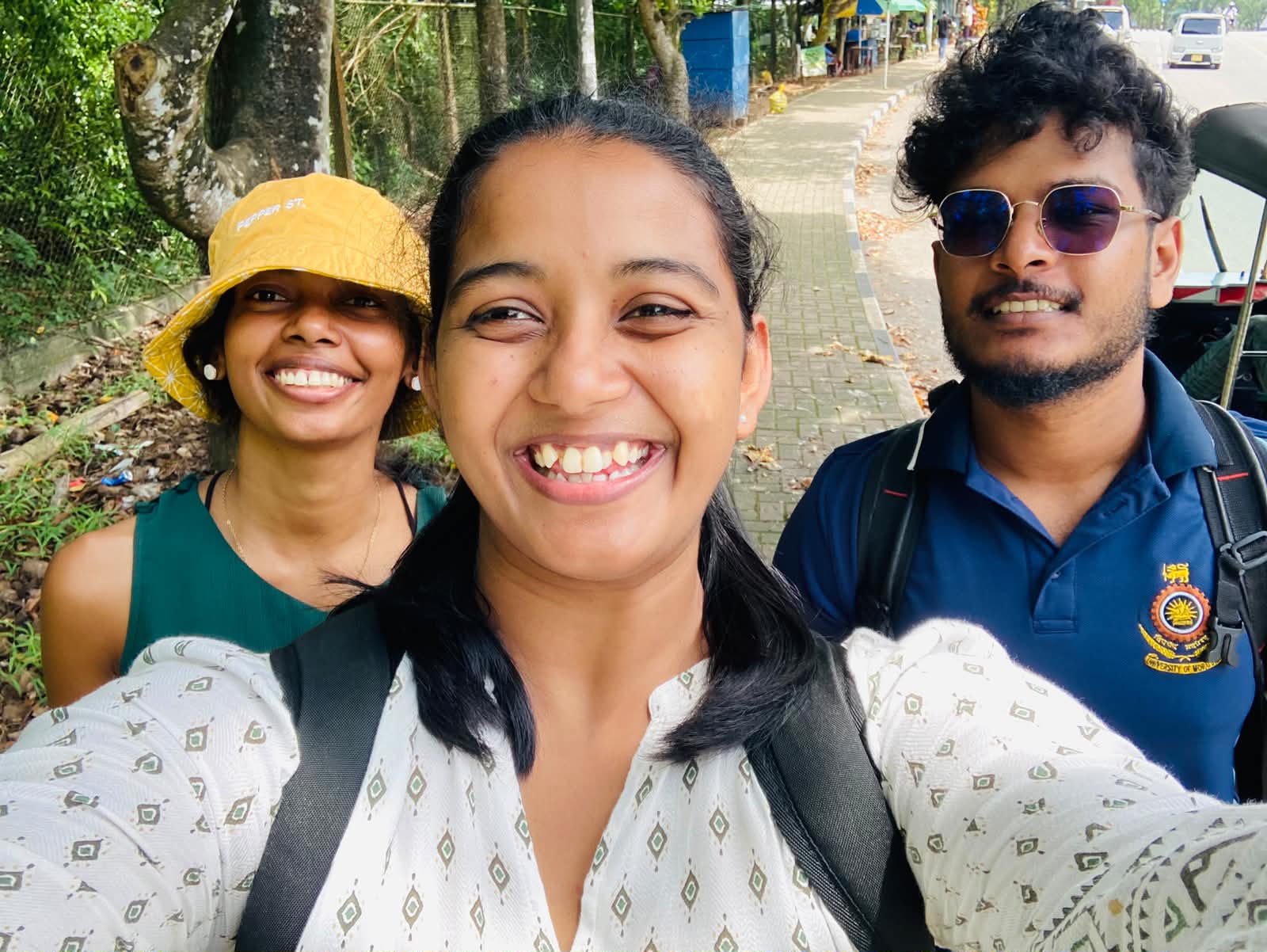
Module 2 connected physical athlete movement with a complete digital intelligence pipeline — beginning with a real safety problem, continuing through wearable-device design and real-time sensor collection, and ending with machine-learning predictions integrated into a broader athlete advisory system.
It reinforced the responsibility involved in building AI systems related to human health and safety — predictions should support athlete development and professional judgement, not replace clinical or coaching expertise.
Sports biomechanics
Wearable computing
Embedded systems
IoT communication
Sensor calibration
Real-time data streaming
Feature engineering
Explainable decision support
Safety-aware product thinking
Final Project Statement
My primary contribution, Module 2, introduced a wearable IMU and machine-learning pipeline for screening lower-limb injury risk — dual BMI160 sensors, a NodeMCU ESP8266, clap-based synchronisation, real-time WebSocket communication, and two independent classification models. It does not diagnose injury; it makes potentially risky movement patterns visible and provides evidence-based support for coaches, athletes and future sports-health assessment.